What Can Diabetics Eat for Breakfast? 9 Options That Won’t Spike Blood Sugar
This article is general information about food choices, not medical advice. Blood sugar responses to the same meal vary from person to person. If you take insulin or other glucose-lowering medication, meal timing and carbohydrate amounts are questions for your doctor or care team.
Why Breakfast Is the Hardest Meal of the Day
If your morning readings run high even on days when you eat carefully, you are not imagining it. Breakfast is genuinely the hardest meal to get right with type 2 diabetes, and there are two reasons why.
First, the body is naturally more insulin resistant in the morning. The same slice of toast that causes a modest rise at lunch can produce a bigger one at 8 a.m. Second, many people start the day already elevated because of the dawn phenomenon, an early-morning hormone shift that prompts the liver to release glucose before you have eaten anything at all.
Put those together and breakfast is not the meal where you can afford to be casual about composition — it is the meal where composition matters most. The good news is that a well-built breakfast works with this physiology instead of against it. You do not need special products or a complicated plan. You need a framework, and a short list of reliable options.
A Simple Framework: Protein, Fiber, Healthy Fat, Controlled Carbs
There is no single perfect breakfast formula for diabetes. The American Diabetes Association’s nutrition consensus report (Evert et al., 2019, published in Diabetes Care) is clear that there is no one ideal macronutrient split — no magic percentage of carbs, protein, and fat — that works for everyone with diabetes. The ADA Standards of Care take the same position.
What the evidence does support is this: the amount of carbohydrate matters, the quality of that carbohydrate matters (fiber-rich and minimally processed beats refined), and pairing carbohydrate with protein and fat slows digestion, so glucose tends to rise more gradually instead of all at once.
That gives you a simple plate to build:
- A protein anchor — eggs, Greek yogurt, cottage cheese, tofu, fish, or leftovers
- Fiber — vegetables, berries, seeds, beans, or whole grains
- A healthy fat — nuts, seeds, avocado, or olive oil
- A deliberate carb portion — chosen on purpose, not whatever filled the plate by default
One more habit is worth trying: eat the protein and vegetables first and save the starchy food for last. When the carb portion lands on a stomach that already has protein, fiber, and fat in it, it is digested more slowly. Many of the foods in our guide to the best foods to control blood sugar work just as well at breakfast as at any other meal.
Finally, treat the carb ranges below as comparison tools, not prescriptions. Your own meter or CGM, if you use one, is the real test of how a given breakfast treats you.
9 Breakfast Options That Keep Blood Sugar Steady
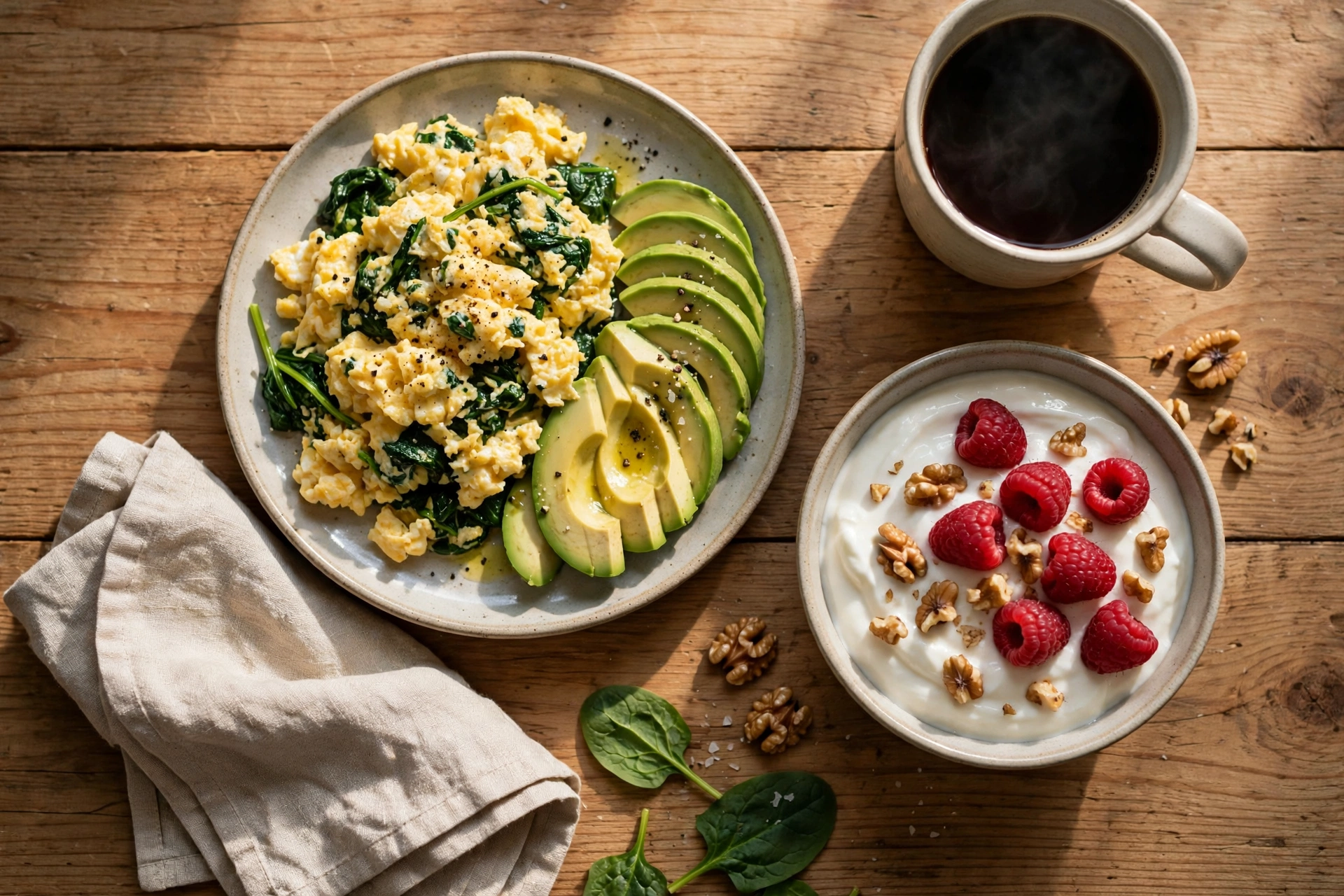
1. Eggs with Sautéed Vegetables and Avocado
Scrambled or fried eggs with spinach, peppers, mushrooms, or tomatoes, plus a few slices of avocado. Eggs provide the protein anchor, the vegetables add fiber, and the avocado adds satisfying fat — with almost no carbohydrate to manage.
Typical carbs: about 5 g or less, depending on the vegetables.
2. Plain Greek Yogurt with Berries and Nuts
Unsweetened Greek yogurt topped with a handful of raspberries or blueberries and a spoonful of chopped walnuts or almonds. Greek yogurt is high in protein, berries bring fiber with less sugar than most fruit, and the nuts slow the whole meal down. Choose plain yogurt — the flavored kind belongs in the “limit” section below.
Typical carbs: about 15–20 g, depending on portion.
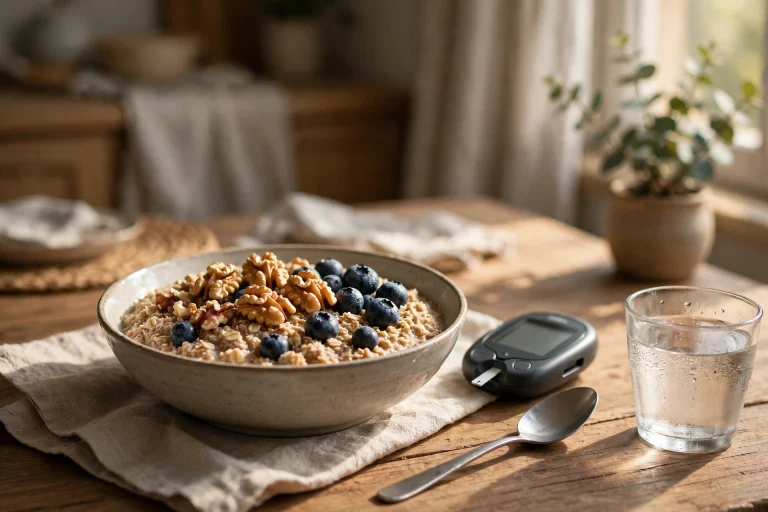
3. Unsweetened Oatmeal with Seeds and Walnuts
Oatmeal has a reputation problem in diabetes circles, but the issue is usually the instant, sweetened kind and the portion. A modest bowl of rolled or steel-cut oats, cooked without sugar and topped with chia or ground flax and walnuts, delivers real fiber — including the soluble kind that slows glucose absorption. Keep the portion modest and let the toppings do the work.
For the full comparison — steel-cut vs rolled vs instant, portions, and toppings that help or spike — see our guide on oatmeal for diabetes.
Typical carbs: about 25–40 g, depending mostly on the portion of oats.
4. Cottage Cheese Bowl with Berries and Seeds
Cottage cheese is an underrated breakfast protein: it is filling, mild, and pairs well with berries, a sprinkle of sunflower or pumpkin seeds, and cinnamon. It digests slowly, which makes it a steady option for people who get hungry again an hour after eating.
Typical carbs: about 10–20 g, depending on how much fruit you add.
5. Whole-Grain Toast with Peanut Butter and a Boiled Egg
One slice of whole-grain toast with natural peanut butter (the kind without added sugar), plus a hard-boiled egg on the side. The toast is the controlled carb portion, and the peanut butter and egg make sure it does not arrive alone. This is the option for people who are not ready to give up toast — and do not have to.
Typical carbs: about 15–25 g, depending on the bread.
6. Tofu Scramble with Vegetables
A plant-based stand-in for scrambled eggs: crumbled tofu cooked with peppers, onions, spinach, and turmeric. Tofu brings solid protein with very little carbohydrate, and the vegetables add the fiber. Serve it on its own or with a small portion of black beans.
Typical carbs: about 5–10 g, a bit more with beans.
7. Chia Pudding with Berries
Chia seeds soaked overnight in unsweetened milk or an unsweetened milk alternative, topped with berries in the morning. Most of the carbohydrate in chia is fiber, so this breakfast is filling and gentle on glucose — and it is ready the moment you wake up, which removes the temptation to grab something worse.
Typical carbs: about 15–25 g, much of it fiber.
8. A Smoothie Built the Right Way
Smoothies fail diabetics when they are really juice and fruit purée in disguise. Build one properly instead: a handful of spinach or kale, a modest portion of berries, plain Greek yogurt or another protein source, and water or unsweetened milk as the base. Skip the juice, honey, and banana-heavy recipes.
Typical carbs: about 20–30 g, depending on the fruit portion.
9. Egg and Black Bean Breakfast Burrito
Scrambled eggs, black beans, salsa, and a little cheese in a small whole-grain tortilla. Beans are one of the best breakfast carb choices available: their fiber and protein slow digestion considerably. Salsa adds flavor for almost no carbohydrate.
Typical carbs: about 25–35 g, depending on the tortilla size and bean portion.
Breakfasts to Limit
None of these are forbidden forever. They are simply the everyday defaults that work against you in the morning, when your insulin resistance is at its highest.
- Fruit juice — even 100% juice delivers the sugar of several pieces of fruit with the fiber removed. Eat the fruit; skip the juice.
- Sweetened cereal — refined grains plus added sugar is the fastest combination to digest on this list, and most people pour more than the serving size on the box.
- Pastries, muffins, and donuts — refined flour and sugar with little protein or fiber to slow them down. A bakery muffin is often closer to a dessert than a breakfast.
- Flavored yogurt — the fruit-on-the-bottom and sweetened varieties can carry as much added sugar as a dessert. Plain yogurt with your own berries is a different food entirely.
- White toast with jam — two refined, quickly digested carbs stacked together, with nothing to slow the rise.
What About Skipping Breakfast?
The honest answer is that the evidence is mixed, and the right choice depends on the person. Some people with type 2 diabetes do well eating their first meal later in the day. Others do not.
One consistent research finding is worth knowing: in studies of people with type 2 diabetes, skipping breakfast was followed by worse glucose responses after lunch and after dinner that same day. Researchers call this the “second-meal phenomenon” — the missed morning meal seems to make the body handle later meals less well, not better.
There is also a safety line that is not negotiable. If you take insulin or a sulfonylurea medication, skipping meals can cause hypoglycemia (low blood sugar). Never change your meal pattern without discussing it with your doctor first.
If you do skip breakfast, know that the night before plays a role in your morning numbers too — what and when you eat in the evening can affect fasting glucose, which is why we covered bedtime snacks for stable overnight blood sugar in a separate guide. And whatever time your first meal lands, its composition matters even more, not less.
Quick FAQ
How many carbs should breakfast have?
There is no single number. The ADA does not prescribe one ideal carbohydrate amount, because the right portion depends on your medication, activity, glucose targets, and personal response. Use the ranges in this article to compare options, and settle your own target with your care team.
Is fruit okay at breakfast?
Yes, for most people — as whole fruit. Whole fruit comes with fiber that slows digestion. The problem is fruit in liquid or sweetened form: juice, smoothies made mostly of fruit, and fruit canned in syrup. Pairing fruit with protein or fat, like berries on Greek yogurt, helps further.
Are eggs okay to eat every day?
Eggs are a common breakfast staple in diabetes meal plans because they are protein-rich and have almost no effect on blood glucose. If your doctor has given you specific guidance about dietary cholesterol, follow that. Otherwise, eggs prepared simply — not fried in lots of butter alongside processed meats — fit well in this framework.
Can better breakfasts actually lower my A1C?
A1C reflects your average glucose over roughly two to three months, so no single meal changes it. But steadier mornings, repeated daily, are one real piece of the pattern that does. For the bigger picture, see our guide on how to lower A1C naturally.
Sources
- Evert AB, Dennison M, Gardner CD, et al. Nutrition Therapy for Adults With Diabetes or Prediabetes: A Consensus Report. Diabetes Care, 2019. (American Diabetes Association consensus: no single ideal macronutrient distribution; carbohydrate quality and pairing matter.)
- American Diabetes Association. Standards of Care in Diabetes (current edition) and nutrition guidance at diabetes.org.
- Centers for Disease Control and Prevention (CDC). Healthy Eating for People with Diabetes. cdc.gov.