Oatmeal for Diabetes: Which Kind Helps, Which Kind Spikes You
Oatmeal has a healthy reputation. It is warm, filling, and cheap. It shows up on almost every list of good breakfast foods.
But if you live with diabetes, you have probably also seen the other side. A bowl of oatmeal can send your blood sugar up fast, sometimes faster than you expected from a “healthy” food.
So which is it?
The honest answer is: oatmeal for diabetes can be a good choice, but only the right kind, in the right portion, with the right toppings. The wrong kind — a sweetened instant packet eaten in a big bowl — can spike you just like a sugary cereal.
This article walks through the difference, step by step.
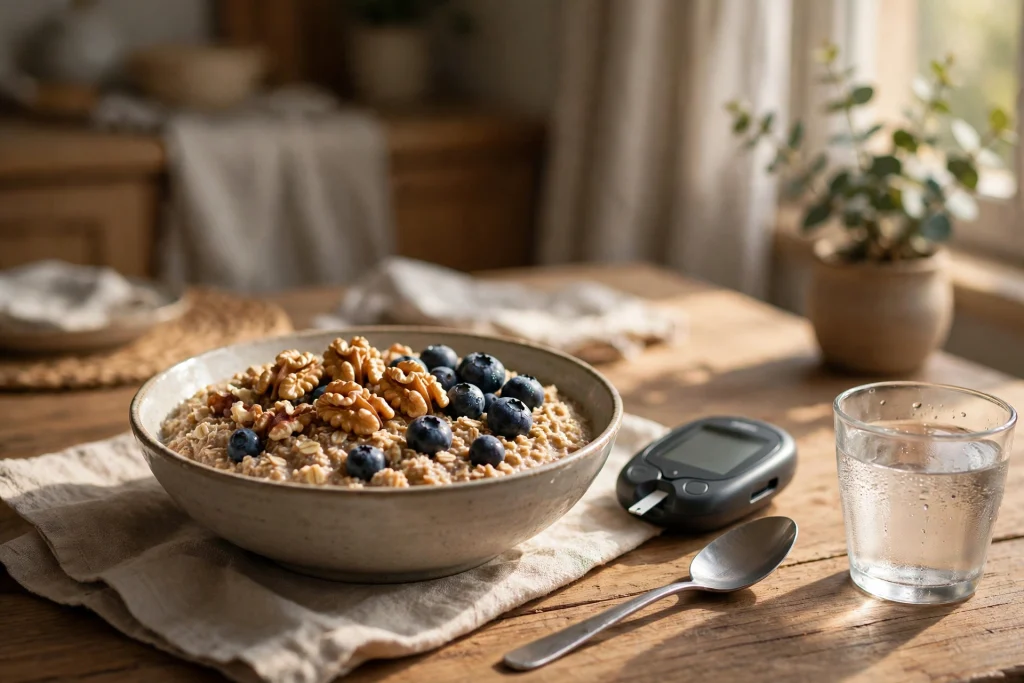
The Short Answer on Oatmeal for Diabetes
Yes, you can eat oatmeal with diabetes. Most people do not need to cut it out completely.
But three things decide whether that bowl helps you or hurts you:
- The type — steel-cut and rolled oats digest slowly. Instant oats digest fast.
- The portion — about half a cup of dry oats is a sensible starting size for most people.
- The toppings — nuts, seeds, and berries treat your blood sugar kindly. Sugar, honey, and dried fruit do not.
Get those three right, and oatmeal can fit into a blood-sugar-friendly breakfast. Get them wrong, and the same bowl works against you.
If you want the bigger picture on morning meals, our guide to the best breakfast for type 2 diabetes shows where oatmeal fits alongside eggs, yogurt, and other steady options.
Why the Type of Oatmeal Matters So Much
All oatmeal starts as the same grain. What changes is how much the factory processes it before it reaches your bowl.
And processing changes everything about how fast your blood sugar rises.
Steel-cut oats: the slowest option
Steel-cut oats are the whole oat grain, chopped into a few pieces with a steel blade. That is all.
Because the pieces are large and dense, your body has to work to break them down. Digestion is slow. Glucose enters your blood slowly and steadily.
That slow, steady rise is exactly what you want with diabetes.
The trade-off is time. Steel-cut oats take about 20 to 30 minutes to cook. Many people cook a big batch on the weekend and reheat portions during the week.
Rolled oats: a close second
Rolled oats — sometimes sold as “old-fashioned oats” — are steamed and flattened into flakes.
They are more processed than steel-cut, so they digest a bit faster. But they still hold together reasonably well in your stomach, and the rise in blood sugar stays fairly gentle for most people.
They cook in about 5 minutes, which makes them the practical everyday choice for many households.
Instant oats and flavored packets: the fast lane
Instant oats are rolled thinner and cut smaller. Some are even pre-cooked. By the time they reach you, much of the digestion work has already been done by the factory.
That means your body barely has to work. The starch turns to glucose quickly, and blood sugar can climb fast.
Flavored packets make this worse, for a second reason we will cover below: many of them carry a surprising amount of added sugar.
The glycemic index, in plain words
Nutrition experts rank foods by how fast they raise blood sugar. That ranking is called the glycemic index.
With oatmeal, the pattern is simple and steady across every version of the ranking:
The more processed the oat, the higher it ranks, and the faster it raises blood sugar.
Steel-cut sits at the low end. Rolled oats sit in the middle. Instant oats sit at the high end.
You do not need to memorize numbers. Just remember the direction: less processing, slower rise.
What Is Beta-Glucan, and Why Do People Keep Mentioning It?
Oats contain a special kind of fiber called beta-glucan.
Here is what it does, in plain words. When beta-glucan mixes with water in your stomach, it forms a thick gel — a bit like the texture of cooked oatmeal itself.
That gel slows everything down. Food moves through your system more slowly. The carbohydrate in your meal turns into glucose more slowly. So instead of a sharp spike after eating, you get a lower, flatter rise.
Beta-glucan is a big part of why less-processed oats behave better than instant oats. The more the oat is broken down in the factory, the less this gel can do its job.
What the research actually shows
So does oatmeal actually improve blood sugar control over time? Researchers have gathered many small studies together — this is called a meta-analysis — to get a clearer answer.
The oat and beta-glucan studies show modest benefits:
- HbA1c — the three-month average blood sugar test — came down by roughly 0.4 to 0.5 points in people with type 2 diabetes.
- Fasting blood sugar — the morning reading before food — improved by a small amount.
Those are real improvements. An HbA1c drop of half a point matters over the long run.
But keep the size of the claim honest. Oatmeal is not a medicine. It will not fix blood sugar on its own, and it does not work like a drug. It is one helpful food inside a bigger pattern of eating, movement, sleep, and — for many people — medication.
Think of it this way: oatmeal is a supporting player, not the star of the team.
Oatmeal Is Still a Carbohydrate — Please Do Not Forget This Part
Here is the trap with oatmeal’s healthy reputation.
Oats are still a grain. A grain is still carbohydrate. And carbohydrate is the part of food that raises blood sugar the most.
A half cup of dry oats contains roughly 27 grams of carbohydrate, before you add milk, fruit, or anything sweet. A full cup of dry oats doubles that.
So the bowl matters as much as the oat. A modest portion of steel-cut oats is a very different meal from a heaping bowl of instant oats with brown sugar — even though both get called “oatmeal.”
This is not a reason to fear oats. It is a reason to respect the portion.
If you are building your overall eating pattern, our roundup of the best foods to control blood sugar for diabetics puts oats in context with the vegetables, proteins, and fats that steady a whole day of eating — not just one meal.
How to Build a Blood-Sugar-Friendly Bowl
Here is a simple way to put it together.
Step 1: Start with the portion
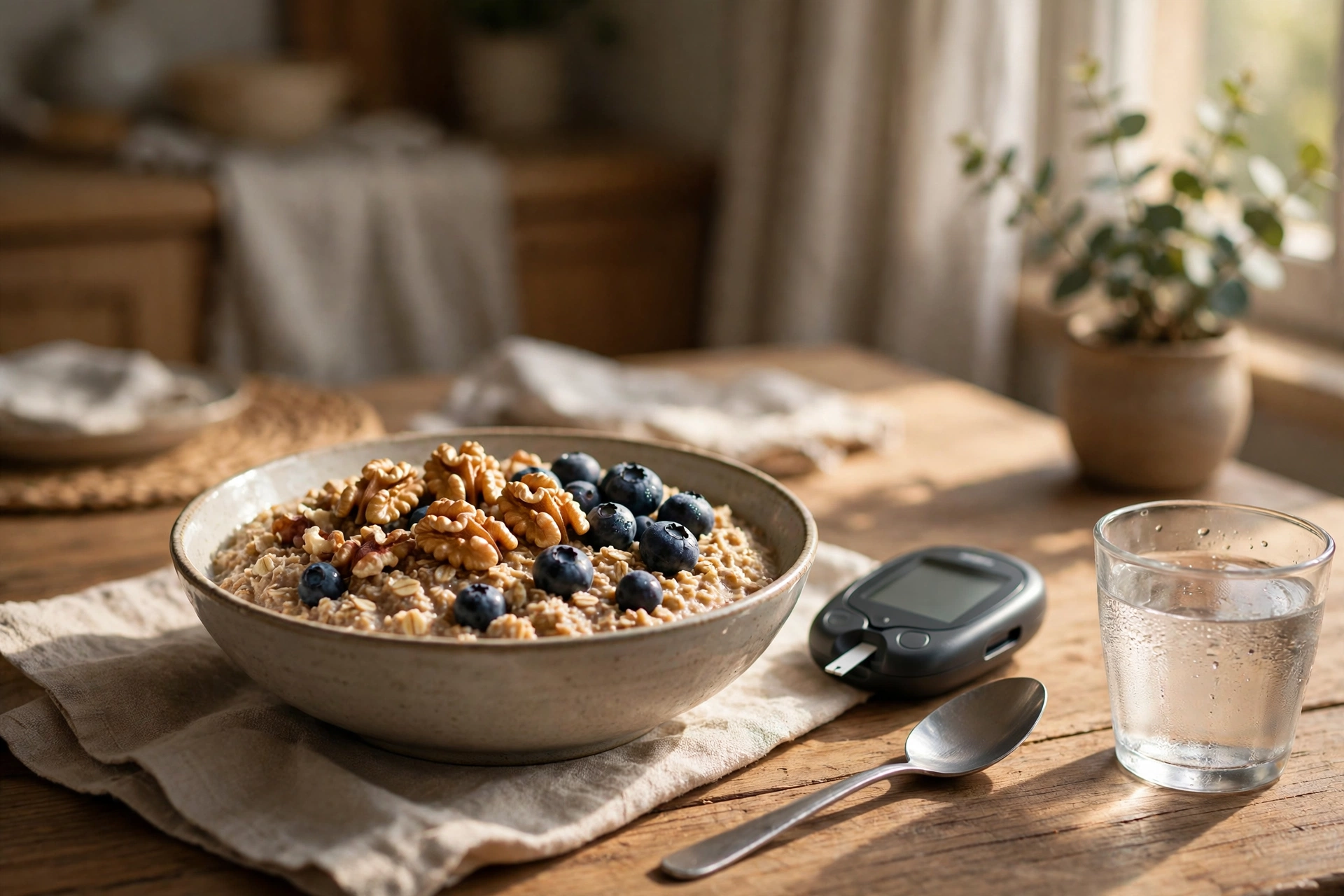
Begin with about 1/2 cup of dry oats. That cooks up into roughly a cup of finished oatmeal.
For many people with diabetes, that is a comfortable size. If your readings run high after breakfast, you can test a slightly smaller portion. If you are very active and your readings stay steady, your care team may be fine with a little more.
Step 2: Pick the slow oat
Choose steel-cut if you have the time, or rolled (old-fashioned) oats as the everyday option.
Save instant oats for rare, rushed mornings — and choose the plain kind when you do.
Step 3: Add protein and healthy fat
Plain oatmeal on its own is almost all carbohydrate. Adding protein and fat slows the whole meal down and keeps you full longer.
Good additions include:
- A spoonful or two of Greek yogurt stirred in or served on top
- A small handful of walnuts, almonds, or pecans
- A tablespoon of chia seeds or ground flaxseed
- A spoonful of peanut butter or almond butter with no added sugar
Step 4: Choose toppings that help, not toppings that spike
Toppings that work in your favor:
- Fresh or frozen berries — raspberries, blueberries, strawberries
- A sprinkle of cinnamon — it adds the flavor of sweetness without sugar
- Chopped nuts and seeds, as above
- A few slices of banana, if your readings tolerate it — go easy, banana is sweeter than berries
Toppings that work against you:
- White or brown sugar
- Honey — it sounds natural, but to your blood sugar it acts like sugar
- Maple syrup
- Sweetened dried fruit, like raisins and sweetened cranberries — the sugar is concentrated, and it is easy to pour on more than you realize
None of this makes a bowl “perfect” or “ruined.” It just tilts the same breakfast toward a gentler rise or a sharper spike.
The Packet Problem: Read the Label Before You Trust It
Instant oatmeal packets look harmless. They are small. They say things like “heart healthy” on the box.
But flavored packets — maple and brown sugar, apples and cinnamon, peaches and cream — often come with added sugar hiding inside, on top of the fast-digesting oats.
So a packet can hit you twice: glucose fast from the over-processed oats, plus a dose of plain sugar.
Two habits protect you:
- Check the “added sugars” line on the label. If a small packet lists several grams of added sugar, treat it like dessert, not breakfast.
- When in doubt, buy plain. Plain instant oats, or better, plain rolled oats, plus your own cinnamon and berries, give you the flavor without the hidden sugar.
It takes one extra minute in the store to flip the box over. That minute is worth it.
Test Your Own Response — Your Meter Knows More Than Any Article
Here is the truth about oatmeal and diabetes: people respond differently.
One person eats rolled oats and sees a gentle rise. Another person eats the same bowl and spikes. Portion size, the rest of the meal, morning hormones, sleep, and stress all play a part.
So do not take this article’s word for it. Test your own bowl.
A simple way to do it:
- Check your blood sugar before you eat.
- Eat your normal oatmeal breakfast — the kind and portion you actually plan to eat regularly.
- Check again about 1 to 2 hours after eating.
That pair of numbers tells you what that exact breakfast does to you. Try it once or twice. If the rise is bigger than you and your care team want, adjust one thing at a time: a smaller portion, a slower oat, or more protein in the bowl.
Our guide to the best time to check blood sugar explains morning, before-meal, and after-meal checks in more detail, including why the timing matters.
Keep a short note of what you ate and what the meter said. Patterns show up fast, and patterns are what let you fix a meal instead of guessing at it.
A Related Read: Another Fiber Worth Knowing
Oats are not the only fiber that forms that helpful gel. Psyllium — a plant fiber often stirred into water — works in a similar slow-it-down way, and research on it and blood sugar is worth a look. You can read our companion piece on psyllium for blood sugar for how it compares and how people use it safely.
Frequently Asked Questions
Can I eat oatmeal every day with diabetes?
For most people, yes — if the portion stays modest, the oat is a slow kind, and the toppings are not sweetened. Daily eating makes your before-and-after checks even more useful, because a meal you repeat is a meal you can fine-tune.
Which is better for blood sugar: steel-cut or rolled oats?
Steel-cut oats digest the slowest, so they usually give the gentlest rise. Rolled oats are close behind and cook much faster. Either is a reasonable choice; both are well ahead of instant.
Are instant oatmeal packets really that bad?
The plain ones are mostly just fast-digesting, which means a quicker rise. The flavored ones add a second problem: hidden added sugar. A packet now and then will not ruin your control, but as a daily habit, slower oats serve you better.
Does adding cinnamon to oatmeal lower blood sugar?
Cinnamon adds sweet flavor without sugar, and that alone helps — you skip the sugar you might otherwise add. Some small studies have looked at cinnamon on its own, with mixed results. Treat it as a smart flavor swap, not as a treatment.
What is the best time of day to eat oatmeal?
Breakfast is the most common time, and the time most studies look at. Some people’s blood sugar runs more sensitive in the morning, so the before-and-after test matters most at breakfast. If your morning readings spike with oats, a smaller portion — or saving oatmeal for later in the day — is worth testing with your care team’s input.
The Bottom Line
Oatmeal for diabetes is neither a hero nor a villain. It is a tool, and like any tool, the result depends on how you use it.
- Pick a slow oat: steel-cut or rolled.
- Keep the portion near half a cup dry.
- Add protein and healthy fat to slow the meal down.
- Sweeten with berries and cinnamon, not sugar or honey.
- Be careful with flavored instant packets.
- And test your own response with your meter, because your numbers matter more than anyone’s general advice.
Do those things, and a warm bowl of oatmeal can stay on your table — working with your blood sugar instead of against it.
This article is for education only and is not medical advice. Talk with your doctor or care team about what portions and foods fit your own treatment plan.