
Best Time to Take Berberine for Blood Sugar: Dose, Timing, and Safety
By Tahir
This article is for general information only and is not medical advice. Berberine interacts with real medications — including diabetes medication. If you take any prescription drug, read the safety section below and talk to your doctor or pharmacist before starting it.
Berberine is one of the few supplements with real clinical trials behind it — and one of the most common questions people ask is also the simplest: when do I take it? Morning or night? Before food or after?
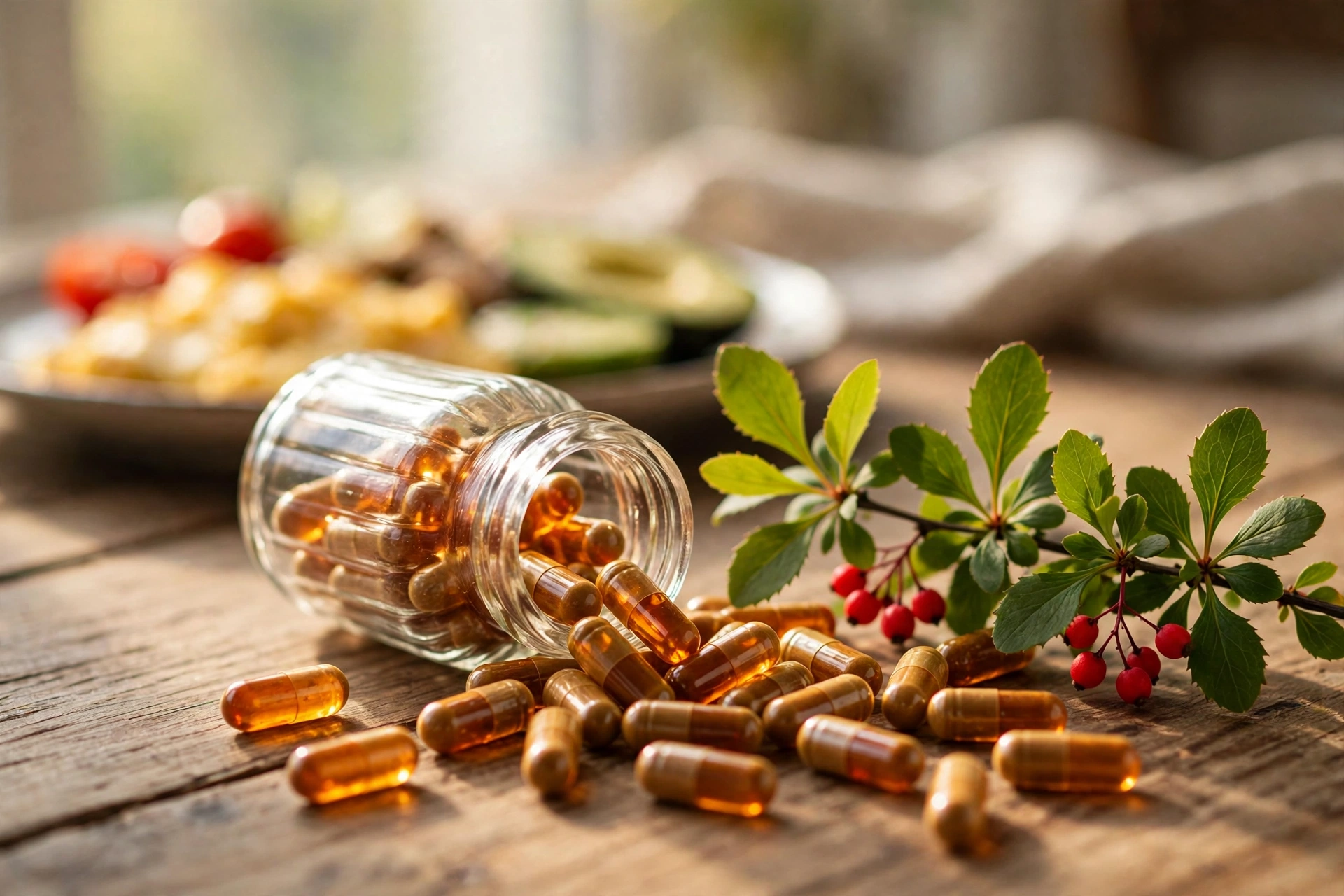
The answer the research points to is not a clock time. It is a meal.
The short answer
Take berberine with a meal, or just before one — and split it into 2 to 3 doses across the day.
That is the pattern used in the clinical trials: 500 mg, two to three times a day (1,000–1,500 mg a day total), taken around meals. Not one big dose in the morning. Not on an empty stomach before bed.
Why “with a meal” is the whole trick
Two reasons, both practical:
1. The spike it targets happens at meals. Berberine’s best-studied effect is on the rise in blood sugar after eating. A supplement aimed at the post-meal spike needs to be on board when the food arrives — which is why trials dose it with or just before meals, and why the biggest meal of your day is the natural anchor for a dose.
2. Your stomach will thank you. Berberine’s most common side effects are digestive: nausea, cramps, bloating, diarrhea, constipation. Food in the stomach softens all of that. The same dose that sits fine with lunch can turn on you taken empty.
Why the dose is split, not single
Berberine does not stay in your system long. Its half-life — the time for half of it to clear — is only a few hours (roughly 4–6 in most reports). One large morning dose peaks and fades by afternoon, leaving your evening meal uncovered, and it hits your gut harder on the way through.
Two or three smaller, meal-timed doses keep levels steadier through the day and are gentler to take. This is not marketing logic; it is simply the schedule the trials used, and matching the studied schedule is the honest way to match the studied results.
How people usually start
Guides and clinicians who use berberine commonly suggest a ramp, not a leap:
- Week 1: 500 mg once a day, with your largest meal.
- Following weeks: build toward 500 mg two or three times a day, with meals, as your stomach allows.
- Judge it at 8–12 weeks, not 8 days. In the trials, the blood-sugar effects build over two to three months. Check in with an A1C test, not a feeling.
What the evidence actually says (no hype)
Pooled results from randomized trials show berberine lowers HbA1c by roughly 0.5 to 0.7 percentage points on average, with fasting glucose down by around 15 mg/dL. That is a real, modest effect — in the neighbourhood of a lifestyle change that works, not a miracle.
Now the honest limits, because they matter:
- Most trials were small and short — around three months — and many were run in one country with uneven quality controls.
- There are no large long-term trials and no data showing berberine prevents heart, kidney, or eye complications.
- The famous “works like metformin” claim traces back to one small pilot study in 2008 with 36 people. Interesting, not proof.
- No berberine product is FDA-approved to treat diabetes.
Our full evidence walk-through is here: berberine for diabetes — what the research really shows.
Side effects to expect
Digestive effects are the headline: nausea, abdominal cramping, bloating, diarrhea, or constipation. In one well-known trial, about a third of people reported temporary stomach effects. In most controlled trials, overall side-effect rates were no higher than placebo — the effects tend to be mild, dose-related, and worse on an empty stomach (see: with a meal, again). Long-term safety past about six months is simply not well studied.
The serious part: interactions
Berberine is not a harmless herb you can sprinkle on top of a medication list. It behaves like a drug in the body, and it mixes like one:
- Diabetes medications (metformin, insulin, sulfonylureas): berberine lowers blood sugar itself. Combined, the two can push sugar too low, and it can stack with metformin’s stomach effects. If you take any glucose-lowering drug, your sugar needs closer monitoring and your doctor needs to know.
- Cyclosporine and similar immune drugs: berberine raises their levels in the blood — flagged by name by the National Center for Complementary and Integrative Health (NCCIH). This one can be dangerous.
- Many other prescriptions: berberine slows down liver enzymes (CYP3A4, CYP2C9, CYP2D6) that clear a long list of common drugs — including some statins, blood-pressure and heart medicines, and blood thinners — which can raise those drugs’ levels too.
The plain rule: if you take prescription medication, berberine is a conversation with your doctor or pharmacist first — not an experiment.
Who should not take berberine at all
- Pregnant or breastfeeding women, and infants. NCCIH warns berberine can build up bilirubin in infants, which in severe cases can harm the brain. This is a hard no, not a caution.
- Children generally — it has not been established as safe for them.
- Anyone whose care team says no after reviewing their medication list.
The bottom line
Best time to take berberine is not a time of day — it is with food, split across your meals, at the studied dose of 500 mg two to three times daily, started low and judged at three months with a real A1C test. Taken that way, the evidence supports a modest blood-sugar benefit. Taken carelessly — on an empty stomach, in one giant dose, or quietly added on top of medication — it is most likely to give you side effects instead.
Working on the bigger picture too? These are the habits that move A1C alongside any supplement: how to lower A1C naturally.
Sources
- Yin et al., Metabolism (2008) — 500 mg three times daily trial protocol and side-effect rates.
- Xie et al., Frontiers in Pharmacology (2022) — meta-analysis of 37 trials: HbA1c, fasting and post-meal glucose effects.
- Lan et al. (2015) — meta-analysis of 27 trials; common dosing protocols.
- NCCIH (National Center for Complementary and Integrative Health) — berberine safety: cyclosporine interaction, pregnancy/infant warnings, evidence quality.
- WebMD berberine monographs — interactions with diabetes medications and monitoring advice.
- NIH LiverTox — berberine adverse-effect profile.

One Comment